Showing posts with label romance. Show all posts

Wednesday, July 22, 2015

"The Time Traveler's Wife" by Audrey Niffenegger (2003)

A most untraditional love story, this is the celebrated tale of Henry DeTamble, a dashing, adventuresome librarian who inadvertently travels through time, and Clare Abshire, an artist whose life takes a natural sequential course. Henry and Clare's passionate affair endures across a sea of time and captures them in an impossibly romantic trap that tests the strength of fate and basks them in the bonds of love.

The interesting thing about this story was that I had heard about it a long time ago, and all I knew was that time-traveling was involved. I'm a huge fan of time-traveling stories, and my impression was that this was a sci-fi, so my boyfriend picked up this book for me. We both discovered that it was a romance, and he gave up on it, haha, but I continued reading. No regrets.

  • For me, the beginning started out intriguing but confusing. There are a lot of elements about time-traveling that they don't quite explain in the book at first, but things get cleared up along the way if you keep reading. However, this makes it a little inconvenient if you're the type to pick a book back up after several days of not reading it.
  • I loved how the author wrote the chapters; they weren't necessarily in chronological order (which sometimes doesn't even make sense anyway, due to the whole time-traveling aspect) but in an order that was able to build up suspense. The pacing of the chapters also helped in creating the suspense. Some chapters were longer than others, but none were unbearably boring or unhelpful, and I liked the details.
  • For some reason, I thought Henry's character started off uncharming. There didn't seem to be anything extraordinary about him, aside from the obvious genetic mishap. But he begins to grow on you as he matures.
  • No matter what you think of Clare, it's hard not to respect this woman for her never-ending supply of patience and strength reflected in her faithfulness. Just... wow. Sometimes though, when her writing style changed to appropriately match her agitation (think long run-on sentences with many "and"'s on end), I got annoyed because it just seems like a very "edgy" thing some authors do when they want minimal effort while appearing super melodramatic. I feel like you can get your point across without dramatically changing the character's narration flow.
  • Also speaking of which, this book is very dramatic. Which is lovely in its own way, but can also come across as hopelessly romantic and a little surreal. The main characters' love story and a few of the side characters (Kimy especially) were the only things that felt real - the rest were a little bit over-the-top, like something you'd see in Hollywood. For instance, Gomez obsessing over Clare for so many years while Charisse was popping out his kids seemed ridiculous. And Ingrid killing herself because of Henry. Even Henry's dad is a little crazy because of love. Everybody acts very Shakespeare-esque because of love, and it's hard to connect that with the other little parts of life. Work (like seriously, academia or actual ambitions) are hardly mentioned. Even friendship isn't as touched upon.
  • Then again, all the characters are artists of some sort. This may be why they seem to play and love all day.
  • The barely-there sci-fi component was probably the most annoying part of the book, in my honest opinion. I liked that the author reached out to be original and explain how the time-traveling gene works, but the genetics explanation also seemed very dumbed-down. Obviously, it wasn't a big part of the novel, but I felt like they just gave us a very basic understanding of how genes work and not really anything substantial about the actual mutation itself, like how it could have occurred (gene/environment interaction?) or the potential damage/success scientists could take from studying such a mutation.
  • The twists along the way were well-implemented - good job, Mrs. Niffenegger, I was not expecting any of those that you threw our way. The quotes about time in the beginning of each part were poignant and particularly relevant, and just made the audience feel more strongly about this love that surpassed even the obstacle of time. In the end, all that suspense built really created something beautiful and powerful. Maybe I'm just emotional, but I did start crying at the end, and that was what told me that this was a really good book.
Rating: 4.5 out of 5 stars!

Monday, September 9, 2013

"Water for Elephants" by Sara Gruen (2006)

Though he may not speak of them, the memories still dwell inside Jacob Jankowski's ninety-something-year-old mind. Memories of himself as a young man, tossed by fate onto a rickety train that was home to the Benzini Brothers Most Spectacular Show on Earth. Memories of a world filled with freaks and clowns, with wonder and pain and anger and passion; a world with its own narrow, irrational rules, its own way of life, and its own way of death. The world of the circus: to Jacob it was both salvation and a living hell.

Jacob was there because his luck had run out—orphaned and penniless, he had no direction until he landed on this locomotive "ship of fools." It was the early part of the Great Depression, and everyone in this third-rate circus was lucky to have any job at all. Marlena, the star of the equestrian act, was there because she fell in love with the wrong man, a handsome circus boss with a wide mean streak. And Rosie the elephant was there because she was the great gray hope, the new act that was going to be the salvation of the circus; the only problem was, Rosie didn't have an act—in fact, she couldn't even follow instructions. The bond that grew among this unlikely trio was one of love and trust, and ultimately, it was their only hope for survival.

Surprising, poignant, and funny, Water for Elephants is that rare novel with a story so engrossing, one is reluctant to put it down; with characters so engaging, they continue to live long after the last page has been turned; with a world built of wonder, a world so real, one starts to breathe its air.

  • I liked it, and definitely thought it was a fun read. It's also sort of dark: the beginning starts out with Jacob's parents' death, and so he is left alone with nowhere to go. Then you see the circus, and you might think "oh, here comes fun!" but keep in mind that this part of the story is all taking place during the Great Depression. The characters all have their dark sides, and I loved how that played out in the story.
  • The interactions with the animals were also quite real, and there is also a shockingly horrifying scene - the climax - that has the elephant as a huge part of it. Honestly, that part disturbed me to the point that I preferred the chimpanzee more. Haha, maybe I just can't stomach certain ideas.
  • I thought Uncle Al and August were greatly portrayed: they're interesting and quirky, a bit mental... Walter and Queenie, I also liked.
  • Jacob serves the usual role of the protagonist in unfortunate circumstances, but unfortunately I didn't feel much for the love interest, Marlena. She's beautiful, blushes a lot, falls in love with Jacob, and happens to be married to someone else. The most interesting part about her was when she was telling her story of how she met August, but otherwise, she didn't seem to stand out to me other than through her "sparkles of sequins" in the show.
Rating: 4 out of 5 stars!

Monday, August 26, 2013

"The French Lieutenant's Woman" by John Fowles (1969)

 
In a feat of seductive storytelling, John Fowles immerses us in the emotionally charged world of a Victorian love triangle and, through a startling act of literary invention, reveals the image of modern man reflected in the past. The French Lieutenant's Woman is perhaps the most beloved of Fowles's internationally bestselling novels; it is universally regarded as a modern classic.

  • First thing I noticed was the beautiful language. The narrative is powerful and descriptive, and the author is obviously capable of bending language for an effective usage. This told me right off the bat that the book would be well-written.
  • The author makes many historical and literary allusions; if you have never heard of Thomas Hardy or Darwin vs. Lamarck (on the theory of evolution), you may not understand such references. But it is cleverly employed on defining the characters, their roles in the story, and thematic events, and I loved the quotes at the beginning of each chapter.
  • The dialogue is also witty, lively, and interesting, and somewhat reminiscent of Victorian classics, but with a modern twist.
  • Honestly, it got a little confusing for me: there are three alternate endings in this book, and it's up to the reader's interpretation what really happened (I had to read up on Wikipedia in order to understand). Once I got it, I thought it was absolutely brilliant and creative, a new take from anything I had ever read before.
  • The only problem I would have with this book is the fact that I simply didn't like one of the important characters, who was consistently shrouded in mystery throughout the book: Sarah. I couldn't understand how she was constantly giving "brief but intense" looks and had the appearance of "submission and dominance" at once. Personally, the love affair just seemed too sudden and based entirely on "fate" and a "love-at-first-sight" appearance, so I couldn't really feel much for the two of them.
  • To the author's credit, his contradictory statements added nice irony and more mystery to Sarah's character, and the build-up of suspense was well-done. I was determined to find out more about Sarah (despite my inability to relate to her).
  • The ending did not disappoint. There are unpredictable twists in all of the alternate endings, making this a fun and interesting story. There is also no rush or outpouring of feelings, which suited the story. Just a sort of settled calm and summation of a philosophy, and I thought that did nicely.

Rating: 4.5 out of 5 stars

Wednesday, August 14, 2013

"The Blue Lagoon" by Henry De Vere Stacpoole (1908)

 
Stacpoole's often-filmed 1908 romance is a classic of lyrical beauty, as two children are castaway on a beautiful island and grow up there, innocent of the real world.

I had this on my Kindle for a while, and had never gone past the second chapter, just because of various distractions. Finally, I sat myself down and finished reading it to the end, and here are my thoughts on the book.
  •  This book is interesting and great for reading on a rainy day with a cup of tea (which was how I read it). Paddy's accent in the beginning made it sort of hard to understand, but that was a challenge I enjoyed and it added on to the language in the story.
  • The narration altogether is a little detached, which is not surprising for a third-person, but the author tells the story clearly. I enjoyed it.
  • The beginning was a little slow (before they get shipwrecked), but I think that most adventure or survival books start out at a slower pace than the latter parts because they're trying to establish the backgrounds of the characters.
  • Honestly, the only reason why I'm not giving this full points is because I wasn't quite sure how to sum up the plot - and then I realize there wasn't really much of a plot. Which is fine, since not all books have to have a plot, but thinking back on it, the story is just weaving a tale of how two children survive on their own and discover the simple joys and frustrations of life. It's realistic and very interesting, but there's not a lot of depth and emotions in it.
  • I loved the ending. If you continue reading on to its sequels, then I suppose you'll find out whether or not the characters are still alive; and if you don't, then... well, it's your interpretation. Personally, I probably will not continue to its sequel, so I'm free to imagine. The whole juxtaposition between sleeping and death is beautifully incorporated.

Rating: 4 out of 5 stars

Wednesday, July 31, 2013

"Memoirs of a Geisha" by Arthur Golden (1997)


MemoirsOfAGeisha.jpg 
A literary sensation and runaway bestseller, this brilliant novel presents with seamless authenticity and exquisite lyricism the true confessions of one of Japan's most celebrated geisha.

In Memoirs of a Geisha, we enter a world where appearances are paramount; where a girl's virginity is auctioned to the highest bidder; where women are trained to beguile the most powerful men; and where love is scorned as illusion. It is a unique and triumphant work of fiction - at once romantic, erotic, suspenseful - and completely unforgettable.

  •  Absolutely beautiful and heartwarming. This is a fairytale and a historical fiction, and may teach you a lot about Japanese culture and the art of being a geisha. Very absorbing and hard to put down.
  • If you've watched the movie and liked it, you will probably like this book even more. The movie does a decent job of portraying everything, but the book has a very "classic" quality to it that makes you feel more for the characters than you do in the movie.
  • I have no idea if I'm the only one who feels this way, but in the end, I felt so bad for Nobu. He seemed to have been wronged by the two people he cared about the most (Sayuri and the Chairman), and he had given so much to them. Admittedly, he's also my favorite character because he seems to have the most personality, so maybe I'm just biased. But I guess his role in the novel is expanded much more than in the movie, giving it more complexities and emotions.
  • The book is written as if it's an actual memoir, but I believe it isn't really..? I loved how the author allows the reader to believe that it's based off true events; the historical context is so accurate and the narration so in-depth that it's hard to believe otherwise!
  • There are funny parts and tragic parts which makes the characters and the setting leap out of the pages and into your head. Everything feels very real, and all the characters are interesting in their own way. Hatsumomo is intriguing as a villain, and Mameha depicted as a reliable and practical older sister figure. Even greedy "Mother" is one of those characters that some people love to hate.
Rating: 5 out of 5 stars.

Thursday, July 18, 2013

"Corelli's Mandolin" by Louis de Bernieres (1994)

 http://upload.wikimedia.org/wikipedia/en/e/e3/Captain_Corelli%27s_Mandolin_1994_book_cover.jpg
Extravagant, inventive, emotionally sweeping, Corelli's Mandolin is the story of a timeless place that one day wakes up to find itself in the jaws of history. The place is the Greek island of Cephallonia, where gods once dabbled in the affairs of men and the local saint periodically rises from his sarcophagus to cure the mad. Then the tide of World War II rolls onto the island's shores in the form of the conquering Italian army.

Caught in the occupation are Pelagia, a willful, beautiful young woman, and the two suitors vying for her love: Mandras, a gentle fisherman turned ruthless guerrilla, and the charming, mandolin-playing Captain Corelli, a reluctant officer of the Italian garrison on the island. Rich with loyalties and betrayals, and set against a landscape where the factual blends seamlessly with the fantastic, Corelli's Mandolin is a passionate novel as rich in ideas as it is genuinely moving.

I picked this book up because I hadn't read many books taking the point of Greece during WWII (then again, I hadn't really been looking haha), and it seemed interesting and had a lot of critical acclaim. The first thing I'd like to point out is how spot-on the synopsis is to the book, except for one detail: I don't know if I'd agree that there are "two suitors vying" for Pelagia's love. But whatever. Will go into that later.

  • This book actually made me cry. That's not a common occurrence for me at all. The story's genuinely moving and engrossing, with characters so real that you can feel their pain, their joy, their awkwardness, and everything else in between.
  • A definite pick-me-up for history lovers. It goes into the predecessor history of Greece, and plunges right into the tragic setting of WWII. Each soldier representative of a country might make you laugh only because of the other character's perspective on their strange behavior and actions, but in the end you understand that they're all the same in that they're people.
  • Be sure to have your vocabulary expanded. This was a definite workout to read because the author's vocabulary is so refined and detailed, and he made sure to have words that described the situation or person perfectly. These won't be commonplace words now, but it adds on to the language and flow of the story.
  • There are a lot of funny parts in here, despite the intense story. Many of them made me snicker or laugh out loud, and the ones that didn't, only didn't because it was subtle British humor. Loved it.
  • The characters are too beautiful: there's the real-hero gentle giant, Carlo, who has been hiding a heavy burden of a secret all his life; the engaging and silly-insouciant titular character, Captain Corelli; the feisty Pelagia; the ugly but motherly Drosoula, who will ultimately choose to love and care for her daughter-in-law over her own son; the eccentric Dr. Iannis; the Nazi Weber, who will eventually be haunted by what he has done to his former friends. Psipsina, the pet of the family, is just as real as her human owners. Even the unsympathetic Mandras is a tragedy.
  • Also very romantic - not in a silly maudlin way, but in a very well-written way. Here, love is clearly delineated from lust and pity: between Corelli and Pelagia, we understand what true love really means, whether it's between lovers or between family members. In the words of Dr. Iannis, it is the affection left over even when all the "passion" is gone.

Rating: 5 out of 5 stars!!

Thursday, July 11, 2013

"The Piano Teacher" by Janice Y.K Lee (2009)

 
In 1942, Will Truesdale, an Englishman newly arrived in Hong Kong, falls headlong into a passionate relationship with Trudy Liang, a beautiful Eurasian socialite. But their love affair is soon threatened by the invasion of the Japanese, with terrible consequences for both of them and for members of their fragile community, who will betray one another in the darkest days of the war.

Ten years later, Claire Pendleton comes to Hong Kong and is hired by the wealthy Chen family as their daughter's piano teacher. A provincial English newlywed, Claire is seduced by the colony's heady social life. She soon begins an affair... only to discover that her lover's enigmatic demeanor hides a devastating past.

As the threads of this spellbinding novel intertwine and converge, a landscape of impossible choices emerges - between love and safety, courage and survival, the present, and, above all, the past.

The novel is split into two time periods: 1940's, and ten years later, both in Hong Kong.
  • Very engaging book. In all actuality though, I found the 1940 storyline much more vivid and interesting than the 1950 storyline; Claire is a boring girl (though I understand that the author probably made her that way to let the readers see her development).
  • Trudy is an extremely singular character, she really stands out in the pages - through her quirks, her fickle observations, etc. She is witty and charming, resourceful and practical, and ultimately proves to be somebody truly good in such a devastating time period, which makes her downfall even more tragic.
  • Will also packs on allure and interest in the story, which is good since he is such an integral part of the novel. He is constantly haunted by his regrets and his past love, and it makes the reader feel for him.
  • The pieces really connect together in the end, as you gather bits of information from everybody in the small community. There are a few things that are never explicitly explained (what spooked Victor with Will in the car, what really happened to Trudy), but it does not distract away from the story and lets the reader interpret these small mysteries using other clues and what is already known. I felt like that really added on to the destructive and chaotic nature of war.
  • Overall, most of the characters are so alive and human that you can feel as if you're really seeing them as you read.
By the time I had reached the end, I was truly sad for these characters, which hardly ever happens to me when I read a book. This is a very well-written historical fiction, and I would highly recommend it for anyone with an interest in WWII, Hong Kong/China, or even anyone who just likes romance.

Rating: 4.5 out of 5 stars.

Friday, February 8, 2013

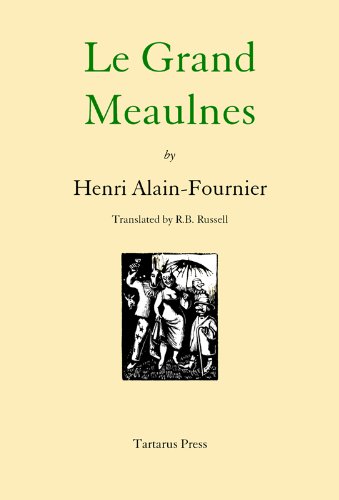
"Le Grand Meaulnes" by Alain-Fournier (1913)

John Fowles described Le Grand Meaulnes as a novel that ‘has haunted the European mind since it first appeared in 1913. It is a novel one never quite forgets, a book like a secret garden...’

Le Grand Meaulnes is a story of the end of youth, with its sense of wonder and idealism, and the transition to adulthood and experience. In a story which exquisitely blends realism with a hint of fantasy, Augustin Meaulnes is haunted by the memory of a beautiful girl briefly encountered in a fantastic ‘domain’. However, Meaulnes finds himself unable to return there both physically and emotionally.

An acknowledged modern classic, Le Grand Meaulnes is offered here in a new translation which is more sympathetic to the poetic original than previous editions.

Ho-hum, it's been a while since my last (and first?) book review.


I bought the translated version a while ago on my Kindle but never really got around to reading it... until now.

Anyway, this is supposed to be one of the most popular classics in France, which was why I was surprised that I hadn't heard of it before... but I finally finished reading, and here's what I thought about it:

  • The beginning moved quite slowly, but I understood that it was essential for the background of the characters to develop.
  • The style is very whimsical and reminiscent of childhood wonders, which means - kudos to the author for evoking such a fitting style, but it doesn't guarantee an enthralled audience.
  • I never understood why it was the grand Meaulnes... especially by the time I got to the end. Felt more like the narrator was the "grand" one for being so caring of his friends, not the titular character, who I thought was kind of a dick.
  • Wonderful twist in the story; everything before that was just too fluffy and overloaded with the typical French romanticism, but when we discover the secret, the book redeems itself.
  • Very sad, and the ending is good... I still think Meaulnes is a dick though.
  • Despite how slow the beginning was and my intense dislike for Meaulnes, I really did like this book and felt very emotional when I reached the end.
Rating: 4.5 out of 5 stars!

I'm sure that the language is much prettier in its native French, but even in English the universal message of love and friendship comes out well. Kudos!

Tuesday, September 4, 2012

"Hotel On the Corner of Bitter And Sweet" by Jamie Ford (2009)

In the opening pages of Jamie Ford’s stunning debut novel, Hotel on the Corner of Bitter and Sweet, Henry Lee comes upon a crowd gathered outside the Panama Hotel, once the gateway to Seattle’s Japantown. It has been boarded up for decades, but now the new owner has made an incredible discovery: the belongings of Japanese families, left when they were rounded up and sent to internment camps during World War II. As Henry looks on, the owner opens a Japanese parasol.

This simple act takes old Henry Lee back to the 1940s, at the height of the war, when young Henry’s world is a jumble of confusion and excitement, and to his father, who is obsessed with the war in China and having Henry grow up American. While “scholarshipping” at the exclusive Rainier Elementary, where the white kids ignore him, Henry meets Keiko Okabe, a young Japanese American student. Amid the chaos of blackouts, curfews, and FBI raids, Henry and Keiko forge a bond of friendship–and innocent love–that transcends the long-standing prejudices of their Old World ancestors. And after Keiko and her family are swept up in the evacuations to the internment camps, she and Henry are left only with the hope that the war will end, and that their promise to each other will be kept.

Forty years later, Henry Lee is certain that the parasol belonged to Keiko. In the hotel’s dark dusty basement he begins looking for signs of the Okabe family’s belongings and for a long-lost object whose value he cannot begin to measure. Now a widower, Henry is still trying to find his voice–words that might explain the actions of his nationalistic father; words that might bridge the gap between him and his modern, Chinese American son; words that might help him confront the choices he made many years ago.

Set during one of the most conflicted and volatile times in American history, Hotel on the Corner of Bitter and Sweet is an extraordinary story of commitment and enduring hope. In Henry and Keiko, Jamie Ford has created an unforgettable duo whose story teaches us of the power of forgiveness and the human heart.

  • While the main character, Henry, is a fairly likeable protagonist, he is very ordinary and on the verge of boring... Sheldon and Mrs. Beatty, side characters, jumped out as characters with more life. Even Henry's father was more intriguing; while he wasn't charming or even likeable, he was very real.
  • The story itself was never exactly boring - I enjoyed reading every page.
  • The "early days" seemed more interesting to me than the "later days," when Henry's interest in the past is revived and he goes looking for it, but I can understand why the author structured the book the way he did, and it was organized cohesively and well, so no objections there.
  • Ending was satisfying enough, but I wish there had been more plot twists or unpredictability.
The story details the endurance of a very innocent first love, and how certain things can be carried on in someone's memory for a lifetime. Also has a lot to do with how love knows no boundaries (mostly in the case of national identity and ethnic aminosity).

Rating: 3 out of 5 stars